7 DIY AC Repair Mistakes That Can Turn a Small Problem Into a Major Repair
When your air conditioner stops cooling on a hot Tampa Bay day, it’s tempting to search for a quick fix and reach for the toolbox. Sometimes, simple troubleshooting is exactly the right first step. Checking the thermostat, replacing a dirty filter, or looking for a tripped breaker may solve a minor problem without a service call.
But DIY AC troubleshooting differs from DIY AC repair. Modern air conditioning systems combine high-voltage electrical components, motors, controls, pressurized refrigerant, and safety devices. Without the right diagnostic tools and training, a seemingly simple repair can damage other components or fail to address the root cause.
Before opening the equipment or ordering replacement parts online, consider these seven common DIY AC repair mistakes.
1. Are You Replacing AC Parts Before Diagnosing the Real Problem?
One of the easiest DIY AC repair mistakes is assuming that a symptom identifies the failed part.
An AC that won’t start, for example, could have a thermostat problem, a failed capacitor, an electrical issue, a safety switch interruption, a control problem, or another underlying cause. Similarly, an outdoor unit that isn’t running doesn’t automatically mean the fan motor has failed.
Replacing the part that seems responsible can leave the original problem unresolved and may even create a new one.
Professional HVAC technicians diagnose the system before recommending a repair. Testing electrical readings, controls, temperatures, pressures, and system operation helps determine why the equipment isn’t working rather than relying on symptoms alone.
2. Does Your AC Breaker Keep Tripping?
Checking the electrical panel is a reasonable troubleshooting step for homeowners. If the AC breaker has tripped, you can verify its position.
The mistake is repeatedly resetting a breaker that keeps tripping.
A circuit breaker is a safety device. A recurring trip may indicate an electrical fault, a failing component, an overloaded circuit, a compressor problem, or another condition that needs diagnosis. Resetting it repeatedly doesn’t eliminate the cause.
If you reset the breaker once and it trips again, stop. Don’t keep forcing the system to restart. Have the cause identified before operating the air conditioner again.
3. Are You Attempting Your Own Capacitor or Electrical Repair?
Online videos can make replacing an AC capacitor, contactor, or other electrical component look surprisingly simple. The risk isn’t always obvious on camera.
Air conditioning equipment contains high-voltage electrical components, and capacitors can retain a charge even after you disconnect power. Replacing a component involves more than finding one that looks similar.
Incorrect specifications, improper wiring, loose connections, or an incorrect diagnosis can create additional equipment problems and serious electrical hazards.
Electrical troubleshooting inside an HVAC system is one area where it’s best to put down the tools and call a trained technician.
4. Are You Trying to Add Refrigerant to an AC That Isn’t Cooling?
If an air conditioner is running but not cooling properly, homeowners sometimes assume it “just needs Freon” or refrigerant.
Air conditioning refrigerant, however, isn’t like gasoline that gets consumed during normal operation. An AC system is designed to operate with a specified refrigerant charge. If the system is low, there may be a leak or another problem that needs diagnosis.
Adding refrigerant without determining the cause and without properly measuring system conditions can result in an incorrect charge and poor system performance.
Refrigerant work is also regulated. The U.S. Environmental Protection Agency (EPA) requires technicians who service equipment in ways that could release regulated refrigerants to meet Section 608 certification requirements.
Learn more about EPA Section 608 refrigerant requirements →
If you suspect a refrigerant problem, this isn’t a DIY AC repair. A qualified HVAC technician can determine whether refrigerant is actually the issue, look for leaks when appropriate, and service the system correctly.
5. Can Cleaning Your AC Coils Cause Damage?
Keeping an outdoor condenser free from leaves and obvious debris is good maintenance. Aggressive cleaning is another matter.
Condenser and evaporator coils have delicate fins that can bend or get damaged. Pressure washers can be too aggressive, while inappropriate cleaning products may damage coil materials or surrounding components. Water directed into electrical areas can create additional problems.
The indoor evaporator coil can be particularly difficult to access and clean correctly without disassembling part of the system.
Homeowners can keep vegetation and loose debris away from the outdoor unit, but deep coil cleaning is better handled as part of professional AC maintenance.
Regular professional maintenance can also uncover developing problems before they become unexpected breakdowns. Gulf Coast Air Systems offers a Comfort Club Maintenance Plan for homeowners who prefer to stay ahead of AC problems rather than wait for a system failure.
6. Is That AC Safety Switch Really the Problem?
Your AC suddenly stops, and you discover that a condensate float switch has shut it down. Bypassing the switch is an easy way to restore cooling.
Don’t do it.
A safety switch is designed to respond to a condition that could cause a larger problem. A condensate float switch, for example, may shut down the system when water isn’t draining properly. Bypassing it without correcting the drainage problem could allow water to overflow and damage ceilings, flooring, or surrounding areas.
The same principle applies to other HVAC safety controls: don’t defeat the device that is warning you about a problem.
Instead, find out why the safety device was activated.
7. Are You Continuing to Run an AC That Is Clearly Struggling?
Sometimes the biggest DIY AC repair mistake is doing nothing.
Homeowners understandably want to keep the AC running during Florida’s heat, even when the system makes unusual noises, cycles repeatedly, freezes up, produces a burning odor, or struggles to cool the home.
Continuing to run a malfunctioning system can add stress to components and may turn a repairable problem into a more extensive failure.
Pay attention to warning signs such as:
When something clearly isn’t right, shutting the system down and having it diagnosed may be the least expensive decision.
What AC Troubleshooting Can You Safely Do Yourself?
Avoiding DIY AC repairs doesn’t mean homeowners can’t do anything when the AC stops working. Several basic checks can provide useful information and sometimes solve simple problems.
Before scheduling AC repair, you can:
These observations can also help your HVAC technician begin the diagnostic process with better information.
When Should You Stop Troubleshooting and Call an AC Technician?
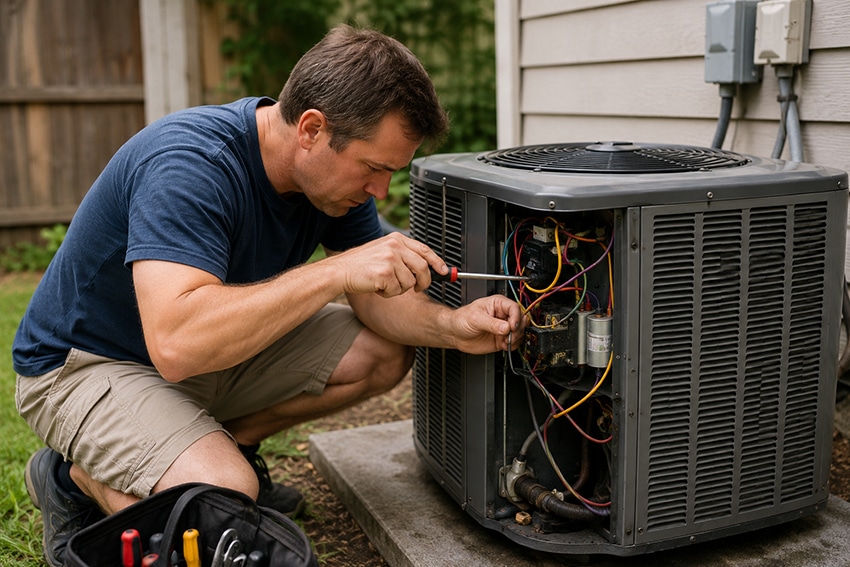
A good rule is simple: if troubleshooting requires opening equipment, testing electrical components, handling refrigerant, bypassing a safety control, or replacing a part, call a professional for diagnosis.
You should also call for service when the same problem keeps returning, or basic troubleshooting doesn’t restore normal cooling.
With decades of HVAC experience and more than 1.4 million AC repair service calls, Gulf Coast Air Systems has encountered problems ranging from straightforward component failures to difficult-to-diagnose system issues. Our NATE-certified, factory-trained technicians repair all makes and models of residential and commercial HVAC equipment throughout the Greater Tampa Bay area.
When an AC problem can’t wait, our radio-dispatched Sprinter fleet is ready to respond with emergency HVAC Repair service. We also offer Saturday service and installation at weekday rates.

Don’t let a small AC problem become a major repair! Contact Gulf Coast Air Systems for professional AC diagnosis and repair in the Tampa Bay area.