

Is a Ductless Mini-Split the Right Choice for Your Florida Home? Pros, Cons & Best Use
Many Florida homeowners hear about ductless mini-split systems and wonder if they are the ultimate solution to high energy bills and uneven cooling. They are praised for being highly efficient, incredibly quiet, and flexible enough to fit into almost any space.
But are they the right choice for every home?
Not necessarily. While a ductless mini-split can solve specific comfort problems that traditional central air conditioning struggles to fix, it isn’t always a one-size-fits-all replacement for whole-home cooling. Understanding both the distinct advantages and the limitations of these systems will help you choose the HVAC setup that truly fits your home, lifestyle, and budget.
What Is a Ductless Mini-Split?
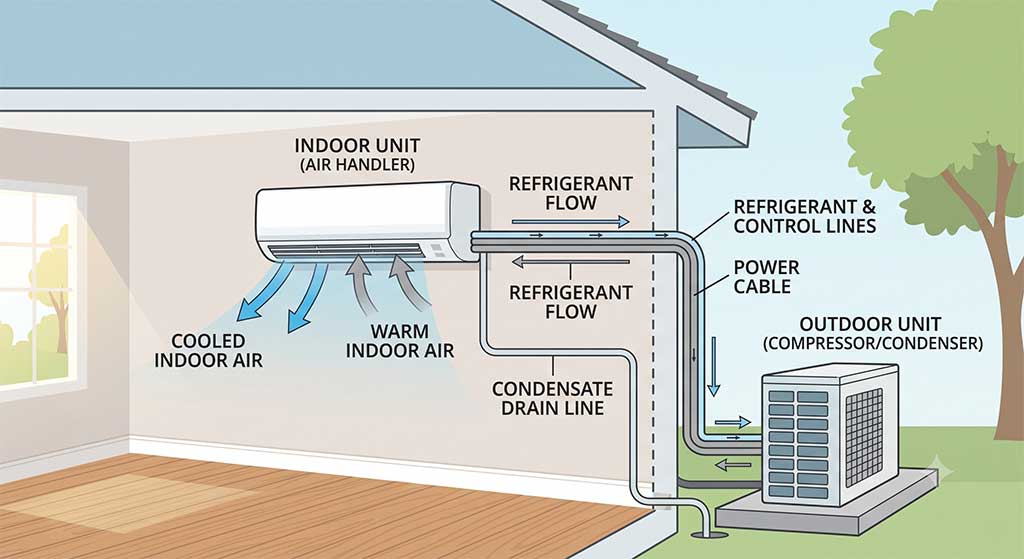
At its simplest, a ductless mini-split is a heating and cooling system that conditions the air without relying on a network of large, hidden ductwork.
The system consists of two primary parts: an outdoor compressor/condenser unit and one or more indoor air-handling units. These components are linked by a small conduit containing power cables, refrigerant lines, and a condensate drain. Instead of blowing air through vents from a central unit, the indoor units are mounted directly on the wall or ceiling of the specific room you want to cool, delivering comfort right where you need it.
When Does a Ductless Mini-Split Make Sense?
Rather than focusing purely on the technology, it helps to look at the specific household problems a ductless mini-split is uniquely designed to solve. In the Tampa Bay area, there are several scenarios where a mini-split shines far brighter than traditional central AC:
- Florida Rooms and Enclosed Lanai: Converting an outdoor porch or sunroom into a livable space is a great way to expand your home, but tying these glass-heavy, high-heat rooms into your existing central AC can overload your main system.
- Garages and Workshops: Standard central AC systems are rarely zoned to handle the high heat and humidity of a Florida garage. A mini-split turns a sweltering garage into a usable workspace or home gym.
- Older Homes Without Existing Ductwork: Historic homes in neighborhoods like South Tampa or St. Petersburg often lack the crawlspace or ceiling clearance required for bulky, modern metal ducts. Mini-splits preserve the architectural integrity of these homes.
- Home Offices and Guest Suites: If you work from home all day, it doesn’t make sense to cool an entire 2,500-square-foot house just to keep your home office comfortable. A mini-split allows you to cool only the room you are currently using.
- Rooms That “Never Cool Properly”: Almost every multi-story or sprawling home has that one back bedroom or upstairs bonus room that stays perpetually stuffy, no matter how low you set the main thermostat.
5 Reasons Homeowners Love Mini-Splits
If your home fits one of the scenarios above, a ductless mini-split offers several compelling benefits:
- Zoned Temperature Control: Family members no longer have to fight over a single thermostat. Each indoor unit operates independently, allowing you to cool the master bedroom while keeping a guest room warmer.
- Exceptional Energy Efficiency: Because there are no ducts, mini-splits eliminate the energy losses associated with traditional central ductwork, which, according to the U.S. EPA’s ENERGY STAR program, can account for more than 30% of a home’s total energy use.
- Whisper-Quiet Operation: The noisy mechanical components sit safely outside your home. The indoor wall units run so quietly that you’ll barely notice they are on.
- Improved Indoor Air Quality (IAQ): Standard ductwork can accumulate dust, pollen, and allergens over time. Ductless systems feature multi-stage filtration in each unit that is easy to clean and keeps airborne particles from circulating between rooms.
- Flexible Installation Options: Instead of tearing open drywall to run massive ducts, installing a mini-split requires only a small, unobtrusive 3-inch hole through an exterior wall.
5 Things to Consider Before Installing One
While the benefits are impressive, a ductless mini-split has distinct limitations that standard marketing materials often gloss over. To make an informed decision, keep these factors in mind:
- Higher Initial Cost for Whole-Home Use: While a single mini-split for a bonus room is highly cost-effective, replacing a whole-house central system with multiple mini-split “zones” can carry a significantly higher upfront cost than a standard central AC replacement.
- Visible Indoor Units: Unlike central AC, where the only visible elements are flush-mounted ceiling vents, a mini-split requires an indoor air handler mounted directly on your wall or ceiling.
- Strict Filter Maintenance: Because these units handle the air directly within the room, their filters must be washed regularly (often every few weeks) to maintain proper airflow and prevent efficiency drops.
- Professional Sizing is Critical: In Florida’s high humidity, an oversized mini-split will cool a room too quickly and won’t run long enough to remove moisture from the air. This can leave your space feeling cold and clammy.
- Central AC May Still Be Best: If your home already has well-designed, functional ductwork, updating to a modern, high-efficiency traditional central AC system is usually the more practical and budget-friendly choice for whole-home comfort.

Mini-Split vs. Central Air: A Quick Comparison
Neither system is universally “better” than the other; the right choice simply depends on your home’s layout and your specific goals.
|
Feature |
Ductless Mini-Split |
Central Air Conditioning |
|---|---|---|
|
Best Application |
Individual rooms, additions, or zone-specific problem areas. |
Consistent, whole-house comfort across uniform layouts. |
|
Ductwork Needed |
None. Perfect for spaces where adding ducts is impossible. |
Relies on an existing network of ducts and grilles. |
|
Temperature Control |
Independent control for every room with an indoor unit. |
One centralized thermostat controls the entire system or large zones. |
|
Installation Footprint |
Small footprint; requires a 3-inch wall hole per unit. |
Requires significant attic, closet, or crawlspace room for duct routing. |
Questions to Ask Before You Decide
Before investing in a new cooling solution, ask yourself these five questions to help narrow down your options:
- [ ] Do I need to cool a single problem room or the entire house?
- [ ] Does my home already have a functional network of ductwork?
- [ ] Am I trying to solve one specific comfort problem, or am I replacing an entire, failing HVAC system?
- [ ] Do members of my household prefer vastly different temperatures in different rooms?
- [ ] Would the labor cost of extending my existing ductwork into a new addition outweigh the cost of an independent mini-split?
A Professional Evaluation Makes the Difference
Every home presents its own unique architectural and thermal challenges. Since 1981, Gulf Coast Air Systems has helped Tampa Bay homeowners choose the right climate solutions based on their home’s specific layout, cooling demands, and long-term financial goals, not simply whatever technology is trending.
Whether that means installing a targeted ductless mini-split to rescue a hot bonus room or recommending a high-efficiency central air system to handle the whole house, their experienced, NATE-certified technicians focus on designing the custom solution that delivers the absolute best performance, humidity control, and value for your investment.
Schedule a Ductless Mini-Split Consultation
Thinking about adding reliable comfort to a garage, home office, new home addition, or an older historic property?
Contact Gulf Coast Air Systems today to schedule an in-home comfort assessment. We will evaluate your space, clearly explain your options, and help you decide exactly which system is the best fit for your Florida home.