
What Are A2L Refrigerants? A Tampa Bay Homeowner’s Guide to R-454B
If you’ve recently received an estimate for a new air conditioner, you may have encountered unfamiliar terms: A2L refrigerants, R-454B, low-GWP refrigerants, or a brand-specific refrigerant name.
What do they mean, and should you be concerned about installing a different type of refrigerant in your Tampa Bay home?
The HVAC industry is going through another major refrigerant transition. New federal requirements are moving newly manufactured residential air conditioning equipment away from higher-global-warming-potential (GWP) refrigerants such as R-410A and toward lower-GWP alternatives.
One alternative is R-454B, an A2L refrigerant now used in many new air conditioning and heat pump systems.
At Gulf Coast Air Systems, we know homeowners shouldn’t need an HVAC certification to understand what we’re installing in their homes. Let’s break down what A2L refrigerants are, why the change is happening, what “lower flammability” actually means, and what the transition means if you already own an R-410A system.
Why Is the HVAC Industry Moving Away From R-410A?
R-410A became a common residential HVAC refrigerant as the industry transitioned away from ozone-depleting R-22. R-410A does not deplete the ozone layer, but it has another environmental concern: a relatively high Global Warming Potential (GWP).
What Is R-454B?
R-454B is a lower-GWP refrigerant developed for use in new air conditioning and heat pump equipment. It is one of several refrigerants manufacturers can use to meet the new federal requirements.
You may also encounter R-32 in newer HVAC equipment. Federal regulations don’t require every manufacturer to use one particular refrigerant; instead, they set GWP limits for new equipment.
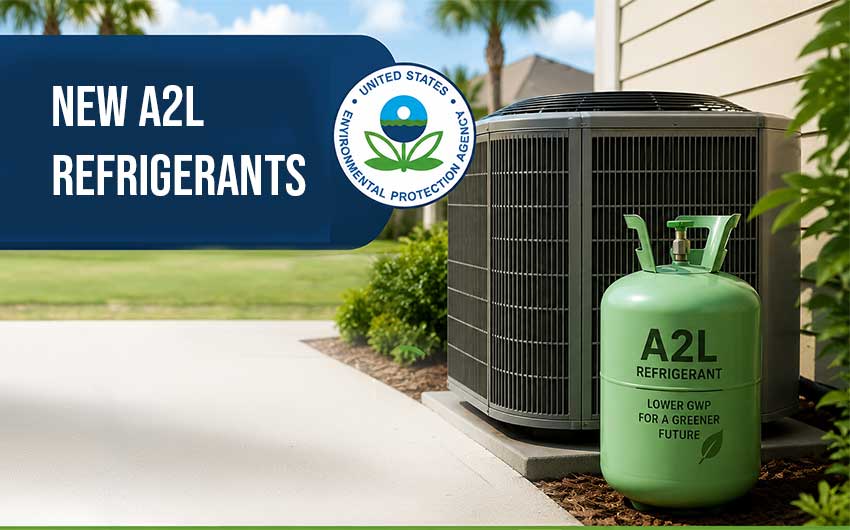
R-454B belongs to a refrigerant safety category known as A2L refrigerants.
And that’s where homeowners often have their next question.
What Does “A2L Refrigerant” Actually Mean?
You may see R-454B described as a “mildly flammable” or “lower-flammability” refrigerant.
The word flammable can understandably sound alarming when you’re talking about equipment installed in your home. But the A2L classification needs some context.
In the HVAC industry’s refrigerant safety classification:
An A2L refrigerant is not like a highly flammable fuel.
A2L refrigerants can ignite under the right conditions, so you shouldn’t ignore their flammability. However, UL Solutions says they are much harder to ignite and less flammable than A3 refrigerants such as propane.
That distinction is important.
The HVAC industry didn’t simply substitute a different chemical into equipment designed for R-410A. Equipment standards, system designs, installation requirements, service procedures, and technician training have evolved to accommodate the characteristics of A2L refrigerants.
How Do New A2L Systems Address Refrigerant Safety?
Modern HVAC equipment designed for A2L refrigerants must comply with applicable equipment safety standards and manufacturer requirements.
Depending on the system design, refrigerant charge, and application, equipment may require a Refrigerant Detection System (RDS).
If the equipment detects refrigerant at a specified concentration, it can automatically initiate mitigation measures. For example, a system may use the indoor blower to circulate air and dilute the refrigerant concentration.
This is an important distinction from saying every A2L air conditioner has the same sensors or responds in the same way. Safety features vary by equipment and application.
This is also why installation matters. Technicians must install and service A2L equipment according to the manufacturer’s requirements and applicable codes, using the latest refrigerant standards.
Are New Air Conditioners Becoming “Smarter,” Too?
The refrigerant transition is occurring alongside another HVAC trend: increasingly sophisticated digital controls and system diagnostics.
Modern HVAC systems may use electronic sensors, communicating components, control boards, and stored diagnostic information to help technicians identify system problems. A2L safety requirements can add another layer of detection and control when the equipment requires it.
Over time, homeowners are likely to see increasingly advanced diagnostics and system controls as manufacturers continue developing connected HVAC equipment.
Haven’t Florida Homeowners Already Been Through a Refrigerant Transition?
Yes, and Gulf Coast Air Systems has helped Tampa Bay homeowners through refrigerant changes for years.
Long-time homeowners may remember R-22, commonly called Freon. R-22 was phased out because of its ozone-depleting properties, and the United States ended production and imports of R-22 in 2020.
During that earlier transition, an unusual type of replacement equipment appeared on the market: “dry” R-22 units that were manufactured without refrigerant and charged in the field.
Gulf Coast Air Systems wrote about the “dry unit” issue and its implications for homeowners as early as 2013.
Today’s transition is different.
R-410A solved the ozone-depletion issue associated with R-22, but its high GWP has become the focus of newer environmental regulations. The current transition is therefore moving new HVAC equipment toward refrigerants with significantly lower climate impact.
For Tampa Bay homeowners, the most important lesson from both transitions is simple: a refrigerant change does not automatically make the air conditioner already in your home obsolete.
Can I Keep My Existing R-410A Air Conditioner?
Yes.
If your R-410A air conditioner is operating properly, you have no reason to replace it just because manufacturers now produce equipment using lower-GWP refrigerants.
You can continue to maintain and repair existing R-410A systems.
EPA rules also allow components using R-410A to continue being manufactured and sold when they are intended for servicing existing equipment. That means the transition isn’t an immediate deadline that requires homeowners to abandon functioning systems.
As the installed population of R-410A equipment gradually declines, refrigerant availability and pricing may change over time. But homeowners should base repair-or-replacement decisions on the condition and economics of their system, not on the fear that R-410A suddenly became illegal.
Can You Still Install an R-410A Air Conditioner in 2026?
This answer changed recently.
In May 2026, the EPA revised its Technology Transitions regulations for residential and light-commercial air conditioning and heat pumps.
Under the updated rules, qualifying equipment using refrigerants above the new 700 GWP limit can still be installed if all specified components were manufactured or imported before January 1, 2025. EPA removed the previous January 1, 2026 installation deadline for this pre-2025 inventory, allowing installation as long as qualifying supplies remain.
However, newly manufactured equipment is transitioning to refrigerants that meet the lower-GWP requirements.
For homeowners comparing replacement estimates, this means you could encounter both R-410A inventory and newer A2L equipment in the marketplace.
Can I Put R-454B Into My Existing R-410A System?
No. R-454B is not a drop-in replacement for R-410A.
An HVAC system must be specifically designed and approved for the refrigerant it uses.
You should not mix R-410A and R-454B, nor should an existing R-410A system be “converted” by removing one refrigerant and adding another.
If your current R-410A system needs refrigerant service, it should continue to use the refrigerant and components specified for that equipment.
Will an R-454B Air Conditioner Cost More?
The refrigerant alone doesn’t determine the cost of a new HVAC system.
New-generation equipment may include redesigned components, safety features, and controls associated with current refrigerant and equipment standards. At the same time, pricing varies considerably by system size, efficiency level, equipment configuration, and manufacturer.
When comparing systems, look beyond the refrigerant label and consider:
An R-454B system isn’t automatically more efficient just because it uses a lower-GWP refrigerant. Efficiency depends on the complete HVAC system and how well it is selected and installed.
Should I Repair My R-410A System or Upgrade to an A2L System?
There isn’t a single answer based solely on the air conditioner’s age.
A well-maintained R-410A system that keeps your Tampa Bay home comfortable may still have useful service life. Replacing it solely because of the refrigerant transition may not make financial sense.
However, when an older system needs a major repair, the calculation changes.
Consider:
A qualified HVAC technician can evaluate your existing system and help you compare repair costs with the long-term benefits of replacement.
What Does the A2L Transition Mean for Tampa Bay Homes?
For Florida homeowners, air conditioning isn’t an occasional convenience. Systems run through long periods of high temperatures and humidity, so equipment selection, installation, and maintenance can significantly affect comfort and operating costs.
The move to lower-GWP refrigerants changes some of the equipment being installed, but it doesn’t change the fundamentals of choosing a good AC system.
The right system still needs proper sizing, correct installation, and ongoing maintenance for Tampa Bay’s demanding climate.
Rather than choosing equipment based only on whether the label says R-410A, R-454B, or another refrigerant, homeowners should consider the entire system and how well it fits their home, comfort expectations, and budget.
Have Questions About Your Current AC or New A2L Refrigerants?
Refrigerant names and changing federal requirements can make buying a new air conditioner seem more complicated than it needs to be.
Gulf Coast Air Systems can help you evaluate your existing equipment, understand your repair and replacement options, and choose an HVAC system suited to your Tampa Bay home and budget.
Whether you keep your existing R-410A system running or consider a new system using R-454B or another approved refrigerant, the goal remains the same: reliable cooling, effective humidity control, and long-term comfort for your Florida home.

Call 813-689-2082 or visit our Contact Us page to schedule service or discuss your air conditioning options.